Four times, the developer behind a nine-home subdivision on Wilkes Drive brought a plan to Colleyville's City Council. Four times, the plan changed shape. The original version, denied outright in February 2023, called for 19 homes starting at $2 million. After three more attempts, the plan that finally cleared council was nine homes on lots averaging roughly 47,000 square feet, with two of the site's fourteen acres carved out for city-owned tree preservation and trails. The council approved The Bluffs at Colleyville on August 20, 2024, and the builders behind it have since been working toward getting homesites construction-ready.
The story usually gets told as a zoning fight. It is really a story about arithmetic. The land at 2417 Wilkes Drive and 6900 Pool Road sits on a slope of old-growth Eastern Cross Timbers forest above Big Bear Creek, and Colleyville's tree preservation ordinance required the builder to keep at least half the trees on site. That single rule, not politics, is what turned nineteen homes into nine. If you are shopping for a wooded lot in Colleyville with plans to build, the same rule is already sitting on whatever parcel you are considering, so it is worth checking before you make an offer.
The trees decide the footprint before you do
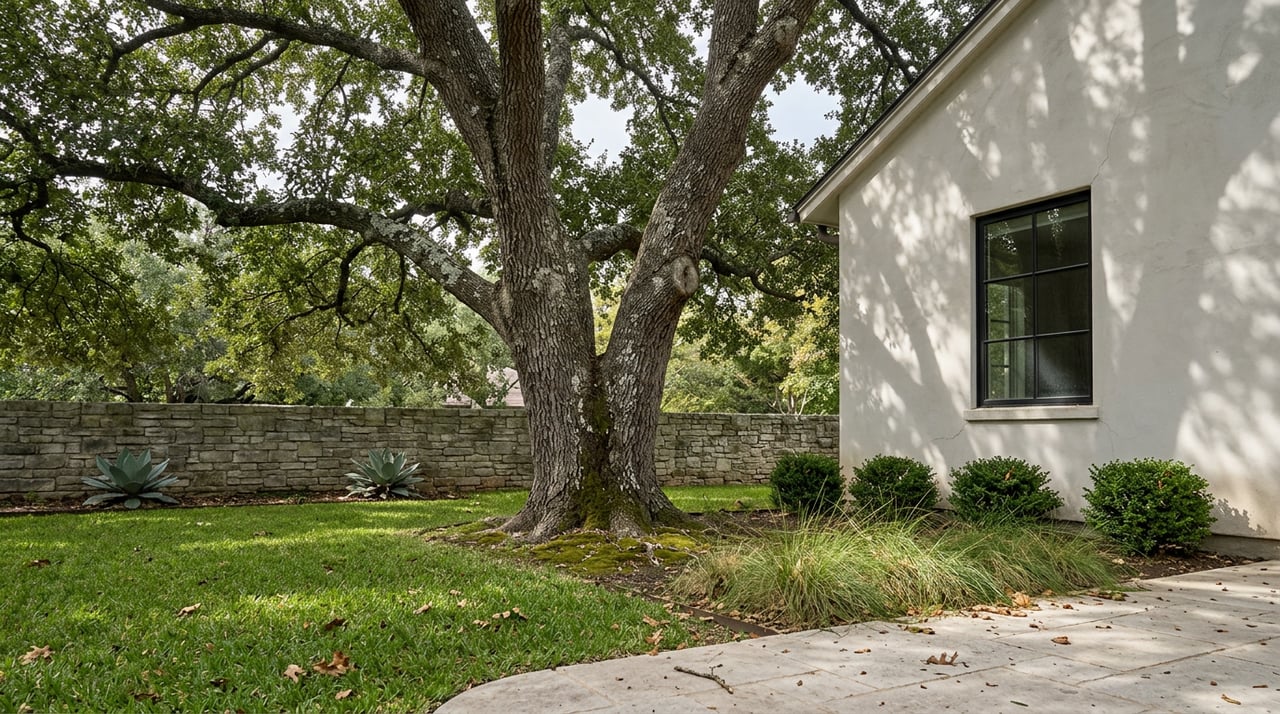
Colleyville's Land Development Code, rewritten most recently in October 2024, defines a Protected Tree as anything with a trunk diameter of six inches or more, measured at four and a half feet above the ground, on what the ordinance calls non-homestead property. That category is broader than it sounds. It covers vacant land proposed for development, and it also covers a home you already own if your renovation plans expand the structure by more than 50 percent of its current square footage. In other words, the ordinance does not just apply to builders buying raw lots. It applies to a homeowner planning a major addition on a lot with mature trees.
Before a permit moves forward on qualifying property, Colleyville's Community Development office says the city requires a Tree Survey and an Urban Forestry Plan documenting every protected tree's location, species, and diameter. That survey is the document that actually tells you what you can build, more than the plat or the appraisal does. A lot that looks buildable on paper can lose square footage the moment the survey comes back and shows a cluster of protected oaks sitting where the garage was supposed to go.
What a tree is actually worth to the city
Colleyville separates ordinary protected trees from Heritage Trees, a smaller category identified for exceptional size or species. Heritage Trees carry stricter protection under a separate section of the code, one that specifically states they cannot be treated as exempt no matter what part of the property they occupy. A homeowner working on their own homestead may have more latitude with an ordinary tree, but a Heritage Tree does not get that same pass.
Remove one lawfully, as part of an approved development plan, and the ordinance gives two paths: plant replacement canopy equal to five times the area of what was removed, or pay into the city's Tree Fund at $100 per inch of trunk diameter. Remove a tree without going through that process, and the numbers change fast.
| Situation | Cost to the property owner |
|---|---|
| Voluntary mitigation for approved Heritage Tree removal | $100 per DBH inch, or replanting at 5x the removed canopy area |
| Unauthorized removal of a protected tree | $250 per DBH inch, paid into the city's Tree Fund |
| Unauthorized removal of a Heritage Tree | $500 per DBH inch, paid into the city's Tree Fund |
Run the math on a single mature oak. A 30-inch heritage oak removed the right way, through an approved plan, costs $3,000 in Tree Fund fees if the builder opts to pay rather than replant. The same tree removed without approval costs $15,000, and the city can delay permit approvals or place a lien on the property until the fee is paid. That is not a rounding error on a construction budget. It is a line item that belongs in due diligence, not in a change order after the framing crew shows up.
Green Source reported that Curtis Young of Sage Group, the developer's representative, said, "We are happy and pleased to finally have The Bluffs at Colleyville approved," when the project cleared council after its fourth attempt. The relief in that statement reads differently once you know what got them there: not a compromise on price or lot count alone, but a compromise measured in canopy inches.
Before you write an offer on a wooded lot
- Ask for a tree survey during the option period, not after closing. If one does not exist, budget for a certified arborist to produce one before you commit to a design.
- Check whether the property counts as homestead or non-homestead under the ordinance's definition. A planned addition over 50 percent of existing square footage changes the classification and the rules that apply.
- Identify any Heritage Trees on the site before the architect finalizes a footprint. Their protection does not lift just because the property is your primary residence.
- Ask the city's Community Development office whether the lot has an approved Urban Forestry Plan on file, since a prior owner's clearing history can affect what is left to negotiate around.
- Price the Tree Fund contingency into your offer the same way you would price a foundation allowance on a lot with known soil issues.
That review process reflects Colleyville’s long-standing approach to protecting its tree canopy.
Why this matters more in Colleyville than elsewhere in the corridor
Colleyville adopted its first tree ordinance in 1993, decades before the current wave of teardown-and-rebuild activity reached the city's older, larger lots. The ordinance has had time to mature alongside the trees it protects, which means the city's Urban Forestry review process is well established and a formal part of the development process. The Bluffs saga proved that even a well-capitalized developer with an experienced land use attorney needed four attempts to reconcile a build plan with the canopy already standing on site.
For a buyer or builder working with the Jeannie Anderson Group on a custom estate in Colleyville, that history is a planning tool, not a cautionary tale to avoid the market. The city's wooded lots, the same slopes and old-growth stands that make Colleyville distinct from newer subdivisions in Southlake or Westlake, are valuable precisely because so few of them remain undeveloped. The ordinance that protects them also protects the character that makes them worth building on in the first place. The buyers who do well here are the ones who treat the tree survey as part of the offer, not an afterthought once the foundation is poured.
FAQ
Does the tree ordinance apply if I am just renovating my current home, not building new? Only if the renovation expands the structure's square footage by more than 50 percent. Smaller renovations on homestead property generally fall outside the non-homestead trigger, though a Heritage Tree on the property remains protected either way.
Who decides whether a tree qualifies as a Heritage Tree? The city's ordinance identifies Heritage Trees by size or species criteria set out in its Land Development Code. A certified arborist or the city's Administrative Official can confirm a tree's status before you finalize a site plan.
If you are evaluating a wooded lot in Colleyville, or comparing what a custom build actually costs once tree preservation enters the picture, the Jeannie Anderson Group can walk the site with you before you write an offer. Request a Luxury Home Valuation to start the conversation with numbers specific to your lot, not a general estimate.
This article is general information, not legal, tax or financial advice. Consult a qualified professional about your situation.